Bringing home a new puppy is exciting, but knowing when to start puppy training can feel overwhelming. The good news? You don’t have to wait. Puppies can begin learning simple commands as early as 7 to 8 weeks old. As they grow up, teaching more complex commands helps build confidence, good manners, and lifelong habits.
At Paws ‘n’ Rec, we’ve seen firsthand how early training helps puppies adjust more easily to new environments, build positive social skills, and grow into confident adult dogs. We’ll go over the basics of how to train a puppy and build their confidence.
Puppy Training Guide at a Glance
- 7-8 weeks: Begin name recognition, crate training, potty routines, and gentle handling.
- 8-16 weeks: Focus on socialization, basic commands, and house training while your puppy is most receptive to learning.
- 3-6 months: Build reliability by adding distractions, leash skills, and impulse control.
- 6-12 months: Reinforce training through adolescence as your puppy tests boundaries and gains confidence.
Why Puppy Training Should Start Earlier Than Most Owners Think
If you’re wondering when to start training a puppy, the answer is as early as 7 to 8 weeks old. Early training takes advantage of your puppy’s natural stages of development, making it easier to build confidence, establish good habits, and prepare them for new experiences.
At Paws ‘n’ Rec, we’ve found that puppies who begin training and socialization early often adjust more confidently to daycare, boarding, and other unfamiliar environments.
The Socialization Window (3–16 Weeks)
Puppies experience a primary socialization window between 3 and 12 weeks, followed by a secondary learning period through 16 weeks. During this time, introduce them to new people, sounds, surfaces, animals, and environments through positive, low-stress experiences.
Why Waiting Until 6 Months Is a Mistake
Waiting until 6 months to start training means missing your puppy’s most important learning period. By then, behaviors like jumping, nipping, and leash pulling may already be established, making them more difficult to correct.
Puppy Training Timeline: What to Teach at Every Age
When you first bring your new family member home, thinking about training can feel overwhelming. This puppy training guide breaks down how to train your pup and a good timeline to follow.
7–8 Weeks — First Days Home
Keep training sessions short—3 to 5 minutes, two or three times a day. You can:
- Teach their name, sit, and come.
- Introduce the crate as a safe, positive space.
- Begin gentle handling of paws, ears, and mouth.
- Establish routines for meals, potty breaks, and sleep.
- If your puppy had a stressful start, focus on trust before new commands.
8–12 Weeks — Foundation Commands
During this stage, you can build on the basics while expanding your puppy’s world. This can include:
- Practicing sit, stay, down, leave it, and loose-leash walking.
- Reinforcing potty training with frequent outdoor trips and rewards.
- Introducing new people, places, surfaces, car rides, and vaccinated dogs.
- Asking for a basic trick before meals, treats, or play.
3–6 Months — Building Duration, Distance, and Distractions
As you’re training a puppy at home, gradually increase the challenge while reinforcing good habits. This can look like:
- Adding the 3 Ds: duration, distance, and distraction.
- Practicing longer stays, recall, and leash manners.
- Redirecting teething with appropriate chew toys.
- Teaching impulse control with simple “wait” cues.
If you want to add challenge without stressing out your pup, now is also a good time to consider puppy training classes or structured daycare visits. Keep in mind that many programs have specific vaccination requirements.
6–12 Months — Adolescence and Reinforcement
Regression is normal during adolescence; think of it like your pup becoming a teenager. Be sure to stay consistent with training and continue practicing the basics.
- Reinforce commands around greater distractions.
- Practice recall, leave it, polite greetings, and calm behavior.
- Continue loose-leash walking and discourage jumping.
- Larger breeds may stay in this stage until 18-24 months.
Core Training Skills Every Puppy Needs at Home
Success with training a puppy at home comes from consistency, patience, and rewarding the behaviors you want to see. These foundational dog training tips will help your puppy build lifelong habits:
Potty Training — The Method That Works
The best tips on potty training a puppy are also the simplest: stick to a schedule and reward success immediately. Take your puppy outside first thing in the morning, after meals, naps, playtime, and before bed. Then, praise and treat them as soon as they eliminate outdoors.
Accidents happen. Clean them with an enzymatic cleaner to remove lingering odors, and never punish or rub your puppy’s nose in a mess. With consistent routines, most puppies are reliably house-trained between 4 and 6 months.
Crate Training — Building a Safe Space, Not a Punishment
A crate should feel like a safe, comfortable space, not a punishment. Start with the door open, place treats or meals inside, and let your puppy explore at their own pace. Close the door for short periods at first to get them comfortable with the process.
As a general guideline, avoid crating a puppy longer than their age in months plus one hour. Puppies that are comfortable in a crate at home also often transition more easily into boarding when the time comes.
Positive Reinforcement — Why It Works and How to Use It
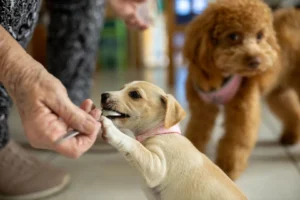
Positive reinforcement means rewarding good behavior immediately with something your puppy enjoys, such as a treat, praise, or play. The reward should come within a second or two, so your puppy connects it with the behavior.
Use high-value treats when teaching new skills or practicing around distractions, then gradually reward behaviors intermittently once they’re reliable. This helps maintain good habits without creating dependence on treats every time.
Common Puppy Training Mistakes to Avoid
Even the best dog training tips won’t work without consistency. Avoiding these common mistakes will help your puppy learn faster and build better habits:
- Don’t wait to start: Begin training around 7 to 8 weeks before unwanted behaviors become habits.
- Keep sessions short: Limit training to 3 to 5 minutes to keep your puppy engaged.
- Stay consistent: Everyone should use the same commands, rules, and house training puppy tips, including a consistent potty schedule.
- Skip the punishment: Redirect unwanted behaviors and reward the behaviors you want instead.
- Prioritize socialization: Introduce your puppy to new people, places, sounds, and other dogs, not just basic commands.
- Say commands once: Give the cue once, then help your puppy succeed before rewarding them.
Many owners think their puppy has become stubborn during adolescence, but this temporary regression is a normal part of development. Instead of giving up or becoming frustrated, go back to basics, use higher-value rewards, and keep training sessions short and positive.
When Professional Puppy Training Makes Sense
Most puppies learn well at home, but some benefit from a little extra support. If your pup is struggling to learn commands, professional training sessions can give them the structure and routine they need to thrive.
Signs Your Puppy Would Benefit From Professional Support
Professional training may help if your puppy:
- Continues biting or nipping after 2–3 weeks of consistent redirection.
- Becomes increasingly fearful of people, dogs, or everyday environments.
- Growls, snaps, or shows signs of aggression.
- Isn’t progressing because training has become inconsistent.
- Is preparing for daycare or boarding and needs supervised socialization.
What to Look for in a Puppy Training Program
In many cases, group classes paired with practice at home provide the best balance of socialization and skill-building. Choose a trainer who uses positive reinforcement, not punishment, and holds recognized credentials, such as CPDT-KA certification.
At Paws ‘n’ Rec, our daycare and boarding programs in Arkansas and Florida reinforce home training through supervised socialization. We make sure your pup is set up for success and a tail-wagging good time.
Puppy Boarding and Training — How It Works
Board-and-train programs allow puppies to stay at a training facility for several days or weeks, where they receive daily instruction, structured routines, and supervised socialization. Some programs focus on basic obedience, while others combine training with daycare or overnight boarding.
The biggest advantage is consistent practice in a controlled environment. Early boarding and socialization can also reduce separation anxiety later on. The best programs also teach owners how to reinforce those skills so training continues long after your puppy comes home.
FAQs
What age should you start training a puppy?
Puppies can start learning the basics at 7–8 weeks, with 8–16 weeks being the most important period for socialization and foundational skills.
How long should puppy training sessions be?
Keep sessions to 3–5 minutes for young puppies and 10–15 minutes by 3–6 months. Short, frequent sessions work best.
How do you potty train a puppy fast?
The best potty training puppy routine is consistency: follow a schedule, reward outdoor potty breaks immediately, and clean accidents with an enzymatic cleaner.
Is it too late to train a 6-month-old puppy?
No. Dogs can learn at any age, and consistent positive reinforcement remains effective even during adolescence.
What’s the difference between puppy training classes and board-and-train?
A group setting, such as puppy training classes, teaches owners alongside their puppies, while board-and-train programs provide intensive daily training and socialization.
How do I choose the best puppy training program?
If you’re searching for puppy boarding and training near you, there are a few factors to consider. Choose a positive reinforcement program that includes owner education and supervised socialization.
Is a dog daycare membership worth it?
For social, energetic puppies, a dog daycare membership provides regular exercise, supervised socialization, and routine, helping reinforce good behavior while giving owners added flexibility.